A buddy of mine sent a message within a group text calling Trump’s chaos-inspired economic policies, “TARIFFic!”. If nothing else, I’m still surrounded by humor.
It’s April 7th, and as the market continues its historical tailspin, I’ve been scouring the Web to find whatever data I can find to relate to the situation the world now finds itself in. Truthfully, there isn’t a whole lot of precedent out there to predict what happens next, when it happens, who it happens to, and why it won’t be Donald Trump.
Donald worries about many things, none of which involves normal Americans and their petty financial needs. Winning the Senior Championship at his posh Florida golf club? Essential. Did Fox and Friends meet their morning quota of compliments? Naturally. Has Vlad responded to the texts from the night before? Ugh, not yet – but it’s early, not even dinner time in Moscow. Would another quick text asking about their next meeting sound too desperate? Probably. Hold steady. Maybe get on that treadmill for the first time?
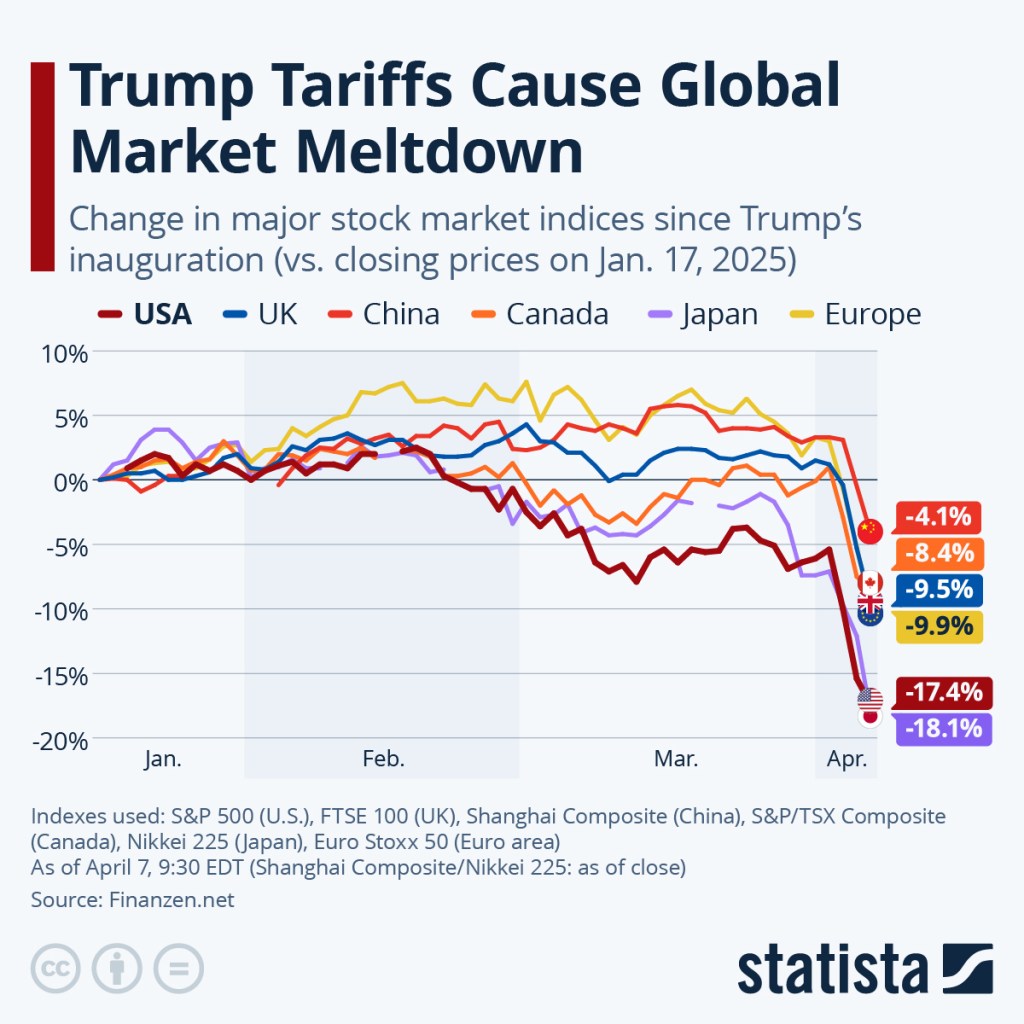
For the rest of us, we are watching our savings the same way we would watch a drunk old man cross a busy road. We are confused, anxious, and distraught over the unknown. It wasn’t that long ago where my wife and I were congratulating ourselves on achieving some personal savings goals in anticipation of our retirement, which creeps ever closer as I hit 59 years of age. Today, those plans are about as likely as the Maple Leafs winning a Stanley Cup.
It does seem like the rest of the Western world are not thrilled with the United States putting all of them on a “trade enemies” list. And, it is ALL of them – plus dozens of other countries that weren’t even aware they exported anything to the United States beyond tins of cookies or macrame wall art.
Historically, tariffs did play a large role in America’s formative years, specifically 1798 to 1913. There were early years where tariffs accounted for upwards of 90% of the government’s entire income. That’s a lot of tea, britches, and bridles. It’s also well before America figured out how to produce essential goods, and subsequently grow into the world’s consumer-spending superpower after the last World War. America’s ability to consume goods in the modern era has also allowed her to accumulate immense power, “finance over fist”, as it were.
Every Administration since Taft has understood this basic tenet of global commerce. That is, until 2016. Donald Trump relied on economic advice from far right isolationist hawks. Howard Lutnick, Kevin Hassett, Peter Navarro and more have had the ear of the President since 2017. Navarro has been especially verbose on the virtues of tariffs, and has written over a dozen books on the subject, mostly targeting China. As a commentary on the depth of these advisors, it was recently discovered that Navarro often quoted an economist named “Ron Vara” to validate his theories in his writings. It turns out Ron Vara was in fact Peter Navarro himself, playing the role of “lazy writer with no friends”. This would be a Grand Canyon credibility gap for most advisors – but this is the Trump Administration, and for now, these revelations are simply charming. Using an anagram of “Navarro” as a pseudonym was especially creative.
Nobody denies that these across the board tariffs will increase revenue for the American government. In 2024, tariffs produced just over $77B in revenue, a paltry 1.57% of total income. Of course, that number will rise – but that’s where we reach a fork in the road. Who will bear whatever increase the government collects?
If you take Donald Trump and his advisors at their word, this is how tariffs work, according to how they campaigned on it in 2024:
- A new car is worth $30,000 in 2024
- In 2025, a tariff of 20%+ is applied to non-domestic parts and/or production, which will impact ALL vehicles sold in the United States, to some degree
- The consumer still pays $30,000 for the vehicle, and the foreign country(s) that owned the production in whole or in part then write a check for $6,000 (20%) to the US government for the pleasure of selling that car to an American buyer
- Bottom line, the consumer won’t feel the tariff at all
- Trump: “We will make over $1T from China, Mexico, Canada and others in 2025!”
The vast majority of non-partisan economists countered these claims, saying tariffs are a consumer tax, working as follows:
- A new car is worth $30,000 in 2024
- In 2025, a tariff of 20%+ is applied to non-domestic parts and/or production, which will impact ALL vehicles sold in the United States, to some degree
- The automobile companies sell that same car at $36,000 to an American buyer
- Bottom line, the consumer pays the tariff
- Democrats: “This will be an enormous tax increase for all Americans, while the uber-wealthy individuals and large corporations receive more tax cuts.”
What isn’t known at this time is what effect a global economic collapse will have on Trump’s bold predictions for a tariff windfall. History tells us that economic fear and uncertainty create nervous consumers. Stock markets in New York, London, Singapore, and Tokyo have seen enormous losses – with New York alone seeing over $11 Trillion in value disappear since January 20th, 2025. What will happen to global supply chains with the cloud of a trade war overwhelming commerce? Is there an inevitable tail effect of job losses on the horizon? This “feels” like we are on the cusp of a full-on recession, but unlike previous crises, we can point to a single person, at a finite point in time, for the cause.
We don’t have to look very far back to see how this could blow up in our face. Trump’s 2018 trade war with China was a disaster, with China moving most of their soybean contracts to Brazil, resulting in American taxpayers having to grant $26B to farmers so they could stay afloat, while millions of metric tons of rotting soybeans stayed dormant in their silos. There were many other products impacted, but agriculture certainly stood out as a worst case scenario.
To unwind this damage is not a small task. Even if the Republican-lead Congress were to wake up and remember that only Congress has the power to implement tariffs, and that they are an equal branch of government as the Founders were pretty explicit about, how much credibility would any representative of this country have on the world stage? In a boardroom?
Ask yourself, would you trust this country if you were on the other side of the table? Is this TARIFFic?
 Get Cozy
Leave a comment