Since I was a young boy, I have been afflicted with asthma. There has been a handful of moments where attacks became so serious as to warrant an emergency room visit, and a thirty-minute stint on a bronchodilator. By and large, my asthma has been treated daily at home with a combination of inhalers, nasal sprays, and common steroidal medications. This has been my life for about fifty years.
I recall many times being told in my youth by various family practitioners that I would grow out of this condition. How I longed for a day where I didn’t have to use an inhaler before and after any sports or seasonal anomaly. So I waited, went through my routine each day, expecting to wake up one morning to realize my breathing was clear. After the first twenty years, I decided to accept my doctors had been wrong all along. Of course, this was WAY before the Internet turned us all into attending physicians, with PhD’s from WebMD-U.
Sadly, my breathing not only didn’t improve, it got worse as I got older. Aging, weight gain, and an unhealthy fixation on cheese were not helpful. Existing medications lost some or most of their effectiveness. There were times where I felt that perhaps I was not intended to live long and prosper. For those of us of a certain age, we know there are not many things in life more sad than disappointing Mr. Spock.

So it was that I saw an ad during a football game for Dupixent. Several middle aged men in the commercial seemed to be having an awesome time with their wives, being active, and laughing loudly in public. A twice-monthly injectable that “may reduce or eliminate the need for your regular inhaler” – yes please. The following week, I met with my pulmonologist and asked if Dupixent is right for me – just like the commercial told me to! And you know what? She said, “What a fantastic suggestion! Why didn’t I think of that? Of course we should try that.”

Okay, that last paragraph never happened. My brilliant pulmonologist put me onto it after a series of alternative treatments didn’t hit the mark. Drug ads are funny.
The great news is that after three months, I’ve noticed a dramatic improvement in my breathing, and far less use of my rescue inhaler. I honestly think I may be soon able to ditch my nighttime COPD inhaler as well, along with the Singulair pill I also take each night. For me, this is about as optimistic as I’ve been about my health – decades in the making.
There is no shortage of innovation when it comes to life sciences in the western world. This innovation comes with a cost, and Dupixent is a prime example. I will preface my comments on price with the fact I have a very strong health care plan through work here in America. Having gone through a rigorous pre-authorization process with Caremark, my prescription insurance provider, and been approved, I hadn’t seen a bill for my first treatments because I had already met my annual deductible late last year. January arrived, and the wizard behind the curtain was revealed.
For one month of Dupixent (two injectable pens), the price was USD$4,222.08. Because my insurance covered a small portion, and the pharmaceutical company company signed me up for “co-pay assistance”, my personal cost would be “only” $3,400 – for a single month. At this cost, my annual deductible was met completely for the entire year on this single transaction. This means going forward, Caremark will fully cover the next eleven months at no out of pocket for me. But I do now have to cover off that entire deductible out of my own pocket, and have used a monthly pay plan. Having hyperventilated (but no inhaler needed!), I decided to jump on the Internet machine and find out what other patients around the “first world” get charged for this American-made drug:
| Country | Gross Monthly Cost (US$) | After Insurance Pay (US$) |
|---|---|---|
| Canada | $1,678 | $0 – $250/month |
| Ireland | $1,961 | $0 – $94.57/month |
| United Kingdom | $2,727 | $25.91 – $2,727/month |
| Finland | $1,984 | $57.93 / month |
| Japan | $786.39 | $150 – $235 / month |
| United States | $4,222.08 | $300-$4,222.08 / month |
Results may vary on what each consumer will pay each month, due to the complexities and completeness of national and private insurance programs deployed abroad. Regardless, we are continually reminded of the vast difference between public healthcare and “healthcare for profit” in the western world. America once again sees 2-3 times what our allies have to pay to get the drug within their borders. Needless to say, medications like Dupixent appear to be available only to the most fortunate of Americans who can afford it – and that is a sad reality.
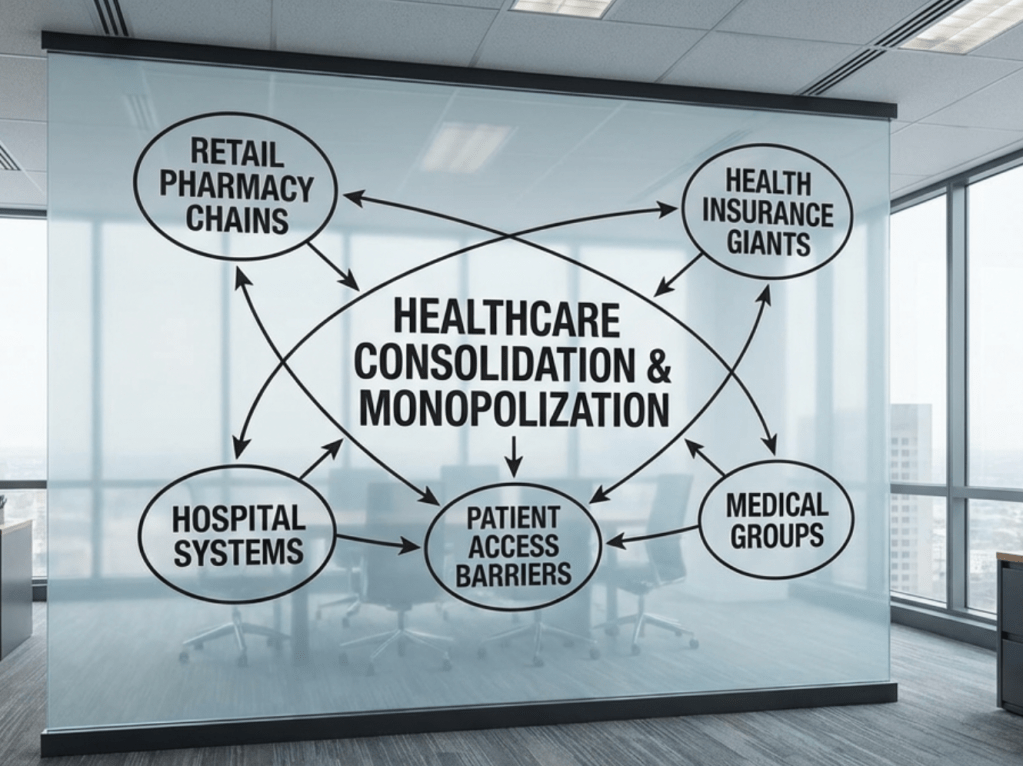
As part of this very informal investigation, I also discovered the miracle of “supply chain monopolization”, or “vertical integration”. Some might call it “We Get All Your Money”. Until today, I was not aware that:
- My main health insurance provider, Aetna, is owned by CVS Health
- My prescription insurance provider, Caremark is owned by CVS Health
- My retail pharmacy where I get all the goods, CVS, is owned by CVS Health
- Oak Street Health, a network of clinics in America catering to the elderly, is owned by CVS Health
For those scoring at home, there are patients in America paying for doctor visits at clinics, who’s insurance reimburses them for various costs, who then prescribe medication for those patients, who’s prescription insurance reimburses them, after picking up those medications at a retail store/pharmacy – ALL transacted upwards through a single, all-powerful, all-knowing corporation called CVS Health, Inc. Isn’t that handy? It certainly helps explain the bottom row in that table above – why bother negotiating with the drug companies if you are simply passing the entire supply chain revenue from the left hand to the right?
Only in America is this possible (if you don’t count Russia, North Korea, or any other despot-ruled autocracy).
 Get Cozy
Leave a comment